
Coordinated FX intervention: everybody's favourite market event
Wild Wild West, Policy vs tactics, Yen crosses, Japan's success is the US's success

FX wild wild west
The foreign exchange market is nearly $10trl of daily OTC transaction, with $3trl of that spot FX. Exchanged traded products are a mere $250bln. The FX market is the Wild Wild West of the global financial markets. Trillions of transactions continuously undertaken based on market convention, good faith, and a few established norms.
Liquidity is episodic throughout the 24 cycle, seasonal, clustered, essentially not guaranteed.
Valuation for individual currencies is continuously debated. Various theoretical frameworks are put forward for valuation or equilibrium pricing, like EER, PPP, or IRP, but huge deviations from fair value are notorious.
The reason is that fiat currencies lack intrinsic value, there is no cashflow. The carry trade, for example, is an attempt to create a cashflow by buying one and selling another.
Capital flows now dominate trade flows and the concept of base currency means little in a world of endless offshore accounts.
This fluid valuation & liquidity reality, and the opaque nature of the OTC market itself, make FX one of the most difficult markets to understand and predict. Which is why the market loves intervention and other forms of powerful shifts in demand and supply. They create scope for frameworks, they temporarily add a few guardrails where none typically exist.
The problem is that in the developed world, or G10+ liquid, free-floating hard currencies world, intervention is rare, and coordinated intervention extremely rare.
They conjure up images of historical accords and the early days of capital market globalisation. Whenever G7 or G5 or even G2 are compelled to intervene together, it is like the new sheriff is in town trying to bring order to the Wild Wild West. It angers some and pleases others.

Policy vs tactics
When analysing the intervention patterns on USDJPY over the past few years it is important to adjust for changes in macro-economic environment, including monetary policy posture at the time. In addition, it is important to distinguish between policy and tactics.
Firstly, the intervention episodes in 2022 & 24 under Fin Min Suzuki lacked any support from BoJ monetary policy. US-Japan interest rates differentials were at their widest in 2024 (5.40% O/N and 4.7% 10Ys). Even though Gov Ueda ended NIRP and YCC in March 2024, the un-pricing of Fed rate cuts for the summer of 2024 sent USDJPY over 160. The ‘policy’ at that time was not to strengthen the Yen. The interventions were risk management.
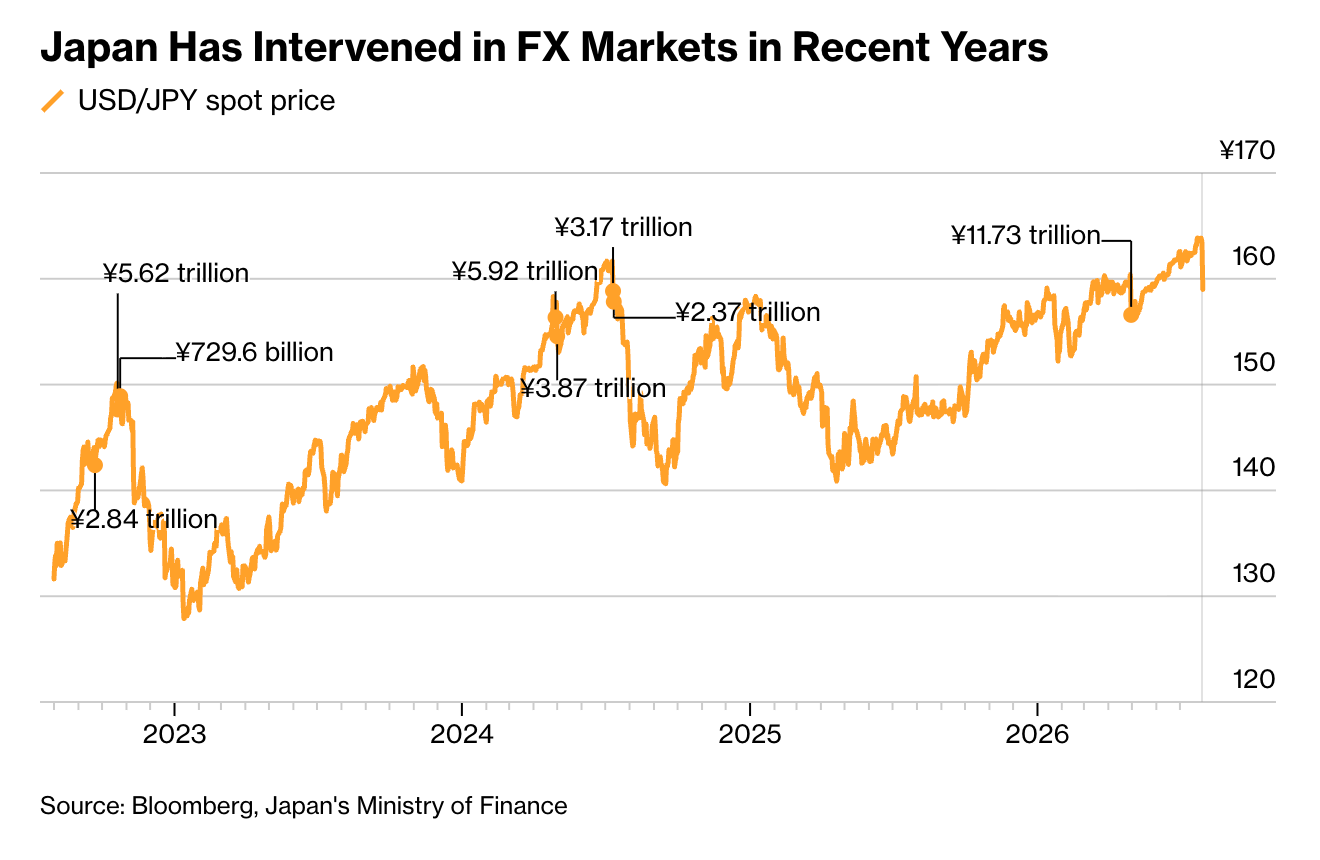
Intervention in 2026 under Fin Minister Katayama, and with Treasury Sec Bessent in office for the US represents totally different circumstances. The policy from the beginning has been to correct Yen undervaluation since at least August 2025 when Bessent first used his ‘behind the curve’ phrase in a Bloomberg interview.
It was further made clear in the U.S.-Japan Finance Ministers’ Joint Statement on September 11, 2025, when then Fin Minister Kata signed an agreement to not target currency weakness for competitive advantage.
After the BoJ raised rates twice in 2025 and the Fed cut three times, the interest rate differential narrowed sufficiently to argue fundamentals for a stronger Yen were in place for 2026. Japan’s 2025 calendar year growth rate was also above 1%, finally closing the negative output gap that had been there since Covid.
Market volatility in January earlier this year forced the US to take a more active role (rate checks) in supporting Japan’s policy pivot on USDJPY. Long term bond yield spikes and fears surrounding PM Takaichi’s fiscal agenda tested the tenuous Yen floor at 160. Inflation risks rising post-Persian Gulf conflict in April tested this floor again.
The tactics have had to change along the way since Sep-25, but the policy is pointed in one direction. The undervaluation must be corrected. The Jan-26 Treasury FX Report kept Japan on the Monitor List, and the Treasury advised that it would now also investigate countries intervening to strengthen their currencies, not just those potentially weakening their currency for competitiveness reasons.
Persistent currency undervaluation is macro-economic condition to be corrected. This was further flagged in the July Report where undervaluation was highlighted (P.29):
